
Why Running Google Ads Is Necessary in 2026: The Complete Utah Business Guide
If you’re running a business in Utah and you’re not on Google Ads yet, you’re handing customers to your competitors every single day. That’s not an exaggeration — it’s just how search works now. This guide breaks down the numbers, the strategies, and the real-world results behind PPC advertising in 2026, specifically for businesses right here in the Beehive State. Whether you’ve tried ads before and got burned or you’re starting from scratch, this is everything you need to know.
📋 Table of Contents (click to expand)
Why Google Ads Still Matter in 2026
Let’s cut right to it. Google processes over 8.5 billion searches per day. That number hasn’t gone down — it keeps climbing, even with AI chatbots and alternative search tools entering the picture. People still go to Google when they need something right now. A plumber at 11 PM. A divorce attorney on Monday morning. A roofing estimate after a hailstorm.
And here’s the thing most business owners miss: the top of Google’s search results page is almost entirely ads. On commercial searches — the ones where someone is ready to spend money — Google shows up to four ads before a single organic result appears. On mobile, that means you’re scrolling past an entire screen of paid placements before you see anything else.
In 2025, U.S. digital ad spending hit $361.9 billion, and it’s projected to reach $413 billion in 2026 — a 14.2% jump. Global search advertising alone crossed $351.5 billion in 2025. Businesses aren’t throwing money at Google Ads because it’s trendy. They’re doing it because it works.
PPC returns $2 for every $1 spent on average — a 200% ROI baseline. Top performers blow past that. The median ROAS across industries sits at 3.5:1, meaning $3.50 back for every dollar in ad spend. For well-optimized campaigns in service industries, we regularly see 5:1 to 8:1 returns.
If you’re a Utah business owner and you’re not running Google Ads, you’re watching competitors take the customers who were searching for exactly what you offer.
The Utah Opportunity: Why Local Businesses Can’t Ignore PPC
Utah isn’t just any state. It’s one of the fastest-growing economies in the country. Utah’s GDP grew 4.6% in 2024 — crushing the national average of 2.8% — and pushed past the $300 billion mark. The tech sector alone accounts for over $30 billion in economic output and employs more than 67,000 people in the Salt Lake metro area.
That growth means more businesses. More competition. More people searching Google for local services.
Here’s what that looks like on the ground:
- Population boom: Utah added over 50,000 residents in 2024. Every one of them needs dentists, HVAC techs, attorneys, restaurants, and contractors. They find those businesses on Google.
- Silicon Slopes effect: Utah’s tech corridor from Lehi to Salt Lake isn’t just creating software companies — it’s creating a population of digitally-savvy consumers who Google everything before making a purchase decision.
- Competition is already here: Disruptive Advertising (Pleasant Grove), Podium (Lehi), and dozens of other marketing companies are headquartered here. Utah businesses are surrounded by competitors who understand digital marketing. If you don’t run ads, someone in your space already does.
- Lower CPCs than coastal markets: Utah isn’t New York or LA. CPCs for local service keywords in the Salt Lake, Ogden, and Provo markets are typically 15-30% lower than major coastal metros. Your ad budget goes further here.
Whether you’re a plumber in Ogden, a med spa in Draper, or a law firm in downtown Salt Lake, PPC puts you in front of buyers the moment they’re searching. No waiting six months for SEO to kick in. No hoping your social media post reaches the right person. Direct, measurable results.
2026 Google Ads Benchmarks That Actually Matter
Numbers without context are useless. Here are the benchmarks that matter for 2026, pulled from WordStream’s analysis of 16,000+ campaigns and WebFX’s 2026 PPC report.
| Metric | 2025 Average | YoY Trend | What It Means |
|---|---|---|---|
| Click-Through Rate (CTR) | 6.66% | ↑ 3.74% | Ads are getting more clicks overall |
| Cost Per Click (CPC) | $5.26 avg | ↑ 87% of industries | Competition is pushing costs up |
| Conversion Rate (CVR) | 4.4% (Search) | ↑ 65% of industries | Better targeting = more leads |
| Cost Per Lead (CPL) | Varies ($80-$819) | ↑ only 5% avg | CPL growth slowed significantly |
| Median ROAS | 3.5:1 | Stable | $3.50 back per $1 spent |
| Display CTR | 0.46% | Flat | Display is awareness, not clicks |
The big takeaway from WordStream’s data: costs went up, but so did conversion rates. That means advertisers who run smart campaigns are getting more leads even as CPCs climb. The ones wasting money? They’re the ones running set-it-and-forget-it campaigns with no strategy.
“Costs are rising, but so is performance — 65% of industries saw better conversion rates in 2025. A smart strategy beats cheap clicks.” — Cliff Sizemore, Senior Marketing Manager, LocaliQ
Campaign Types Breakdown: Search, PMax, Demand Gen, and More
Google Ads isn’t just “search ads” anymore. The platform has expanded into multiple campaign types, and knowing which ones to run (and when) is the difference between burning cash and printing money.
Search Campaigns
Still the bread and butter. Someone types “emergency plumber Ogden” into Google, your ad shows up at the top. Search campaigns capture high-intent traffic — people who are ready to buy, call, or book right now.
- Average CTR: 6.66%
- Average conversion rate: 4.4%
- Best for: service businesses, local companies, lead generation
- Utah context: local service keywords in Utah markets tend to convert higher than national averages because competition is lower than coastal cities
Performance Max (PMax)
Google’s AI-powered campaign type that runs across all Google channels — Search, YouTube, Display, Discover, Gmail, and Maps — from a single campaign. You give it your creative assets and conversion goals, and Google’s AI figures out where to place your ads.
- Best for: ecommerce, multi-channel reach, businesses with strong creative assets
- New in 2025-2026: negative keyword support, ad network breakdowns (you can now see if Search, YouTube, or Display is driving your conversions), and A/B experiment support
- Watch out for: PMax can eat budget on low-quality Display placements if you don’t monitor it. Always check your placement reports.
AI Max for Search
This is Google’s newest play — a keywordless search campaign powered entirely by AI. It’s expected to eventually replace Dynamic Search Ads. Google may announce DSA deprecation as early as Q2 2026, pushing advertisers toward AI Max.
- How it works: you provide your landing pages and goals, Google’s AI determines which searches to show your ads for
- Best for: advertisers with large keyword footprints who want to find new search terms they wouldn’t have thought of
- Risk: less control over exactly which queries trigger your ads. Requires close monitoring of search term reports.
Demand Gen Campaigns
Designed for awareness and consideration — these run on YouTube, Discover, and Gmail. Think of them as the Google Ads version of social media advertising. Visual, scroll-stopping creative that reaches people before they start searching.
- Best for: brand awareness, new product launches, reaching people early in the buying journey
- Google’s recommended 2026 budget split: 30-40% of total ad spend for businesses that need top-of-funnel reach
Local Services Ads (LSAs)
If you’re a service business in Utah, LSAs deserve attention. These are pay-per-lead (not pay-per-click) ads that appear at the very top of Google — above even regular search ads. You get the Google Guaranteed badge, which builds instant trust.
- Available for: plumbers, electricians, HVAC, locksmiths, lawyers, real estate agents, and more
- Cost model: you pay per lead, not per click. A lead is a phone call or message from a potential customer.
- Utah advantage: LSAs are less competitive in Utah markets than in major metros, meaning lower cost per lead
AI Max, Performance Max, and the New Automation Playbook
Google is betting everything on AI. If you’ve logged into Google Ads recently, you’ve probably noticed how aggressively they push automated features. Here’s what’s actually useful versus what’s just Google trying to spend your money for you.
What’s Actually Working in 2026
- Smart Bidding (Target CPA / Target ROAS): These bidding strategies use Google’s machine learning to optimize your bids in real-time based on hundreds of signals — device, location, time of day, audience signals, and more. For campaigns with enough conversion data (at least 30 conversions per month), Smart Bidding typically outperforms manual bidding.
- Broad Match + Smart Bidding: This combination was risky two years ago. In 2026, it works well if you pair it with strong negative keyword lists and keep your search term reports clean. Google’s AI has gotten genuinely better at understanding intent.
- Performance Max network breakdowns: The new API v23 update lets you see exactly which Google network (Search, YouTube, Display, Discover) is driving your PMax results. This was a massive blind spot that Google finally addressed.
- AI-generated creative variations: Google is testing auto-generated video and image assets within PMax. By late 2026, expect campaigns to automatically create new ad variations based on performance data.
What to Watch Out For
- Auto-applied recommendations: Google will automatically apply “recommendations” to your account if you don’t opt out. Some of these are fine. Others — like automatically raising your budget or adding broad match keywords — can blow through your spend fast. Turn off the ones you don’t want.
- AI Max’s search query coverage: Keywordless search sounds futuristic, but it also means less control. If you run AI Max, check your search term reports weekly.
- PMax cannibalizing Search: PMax can pull traffic away from your dedicated Search campaigns. If you run both, watch for overlap and use campaign-level experiments to test performance.
Google Ads vs. SEO vs. Social Ads: The Real Comparison
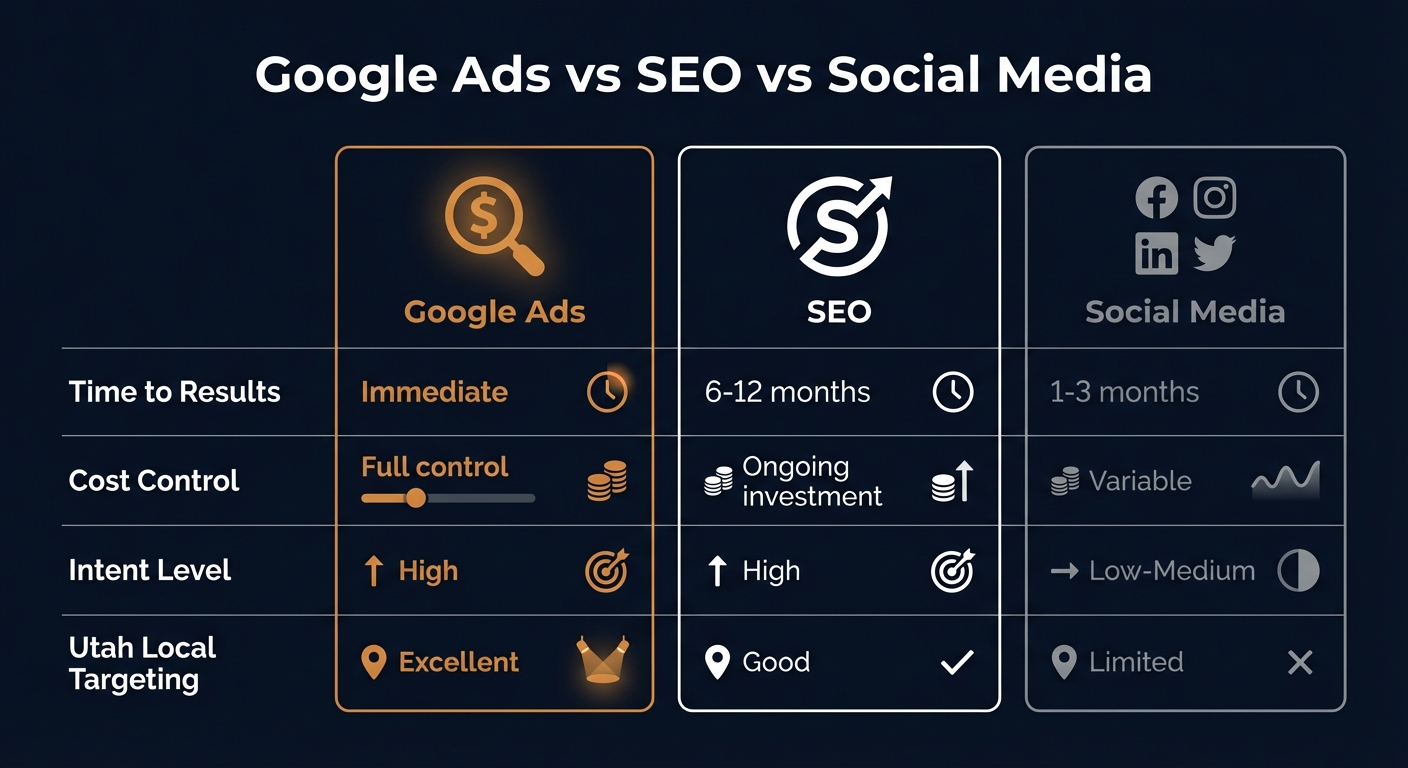
This is the question every business owner asks: “Should I do Google Ads, or should I just invest in SEO?” The answer is both, but let me explain why Google Ads is the one you can’t skip.
| Factor | Google Ads | SEO | Social Media Ads |
|---|---|---|---|
| Time to results | Hours | 3-6+ months | Days |
| Average ROI | 200% baseline, 350%+ median | Up to 748% long-term | Varies wildly (50-200%) |
| Intent level | High (they’re searching for it) | High (organic clicks) | Low (interruption-based) |
| Control | Full (budget, keywords, schedule) | Limited (Google’s algorithm) | Moderate (audience targeting) |
| Scalability | Instant (increase budget) | Slow (more content, more links) | Moderate |
| Predictability | High (data-driven) | Low (algorithm changes) | Medium |
| When you stop paying | Traffic stops | Traffic continues | Traffic stops |
SEO is a long game. It delivers 3.7x higher ROI than Google Ads on average — but that’s over years, not weeks. And SEO in 2025-2026 is more volatile than it’s ever been. Google pushed major algorithm updates throughout 2025, and AI Overviews have started eating into organic click-through rates on informational queries.
Social media ads (Facebook, Instagram, TikTok) reach people who aren’t actively looking for your service. That can work for brand awareness, but conversion rates are significantly lower because you’re interrupting someone’s scroll rather than answering their search.
Google Ads captures demand that already exists. When someone searches “roof repair Salt Lake City,” they need a roofer. Right now. That’s the highest-intent traffic you can buy. SEO might get you there eventually, and social ads might plant a seed — but Google Ads puts you in front of a buyer today.
The smartest approach? Run Google Ads for immediate lead flow while investing in SEO for long-term compounding growth. They’re not competitors — they’re complements.
What Happens When Utah Businesses Skip PPC
We talk to Utah business owners every week who’ve been “thinking about” Google Ads for months or years. Here’s what we see happening to the ones who keep putting it off:
- Competitors eat their lunch. Your competitor is bidding on “your service + your city” right now. Every search they capture is a customer you lost. In competitive Utah markets like legal, dental, HVAC, and home services, the businesses running ads are getting 50-70% of the available leads.
- They rely entirely on referrals. Referrals are great. They’re also unpredictable and unscalable. One slow month and you’re sweating payroll. Google Ads gives you a consistent, controllable flow of leads that you can turn up or down based on capacity.
- They get crushed by algorithm updates. If your only source of online leads is organic search, one Google algorithm update can tank your traffic overnight. Businesses that got hit by the 2024-2025 Helpful Content Updates lost 30-60% of their organic traffic. The ones running ads? They kept getting leads through the entire ordeal.
- They can’t test messaging or offers. Google Ads gives you real-time market feedback. You can test different headlines, offers, and landing pages within days and know exactly what resonates with your audience. Without ads, you’re guessing.
- They miss the “I need this NOW” customers. Paid search drives roughly 15% of total website traffic, but that 15% converts at dramatically higher rates because it’s high-intent. Organic captures more volume but includes a lot of browsers and researchers. Paid captures buyers.
Industry Benchmarks: Service Businesses, Legal, Home Services, Medical
Utah’s economy runs on service businesses. Here are the Google Ads benchmarks for the industries we work with most, based on 2025 data from WordStream and WebFX:
| Industry | Avg CTR | Avg CPC | Avg CVR | Notes |
|---|---|---|---|---|
| Attorneys & Legal | 5.97% | $8-$15+ | 3.5-5% | High CPC but massive case values offset it |
| Home & Home Improvement | 6.37% | $4-$9 | 3-5% | Strong Utah market with year-round demand |
| Dental Services | 5.44% | $5-$10 | 4-6% | Competitive in Wasatch Front markets |
| Health & Fitness | 7.18% | $3-$7 | 4-6% | Med spas and wellness booming in Utah |
| Automotive (Repair/Service) | 5.56% | $3-$6 | 5-7% | Low CPC, strong conversion rates |
| Real Estate | 8.43% | $2-$5 | 3-4% | Utah’s hot housing market drives search volume |
| Personal Services | 7.69% | $3-$6 | 5-8% | Cleaning, moving, pet care — high conversion |
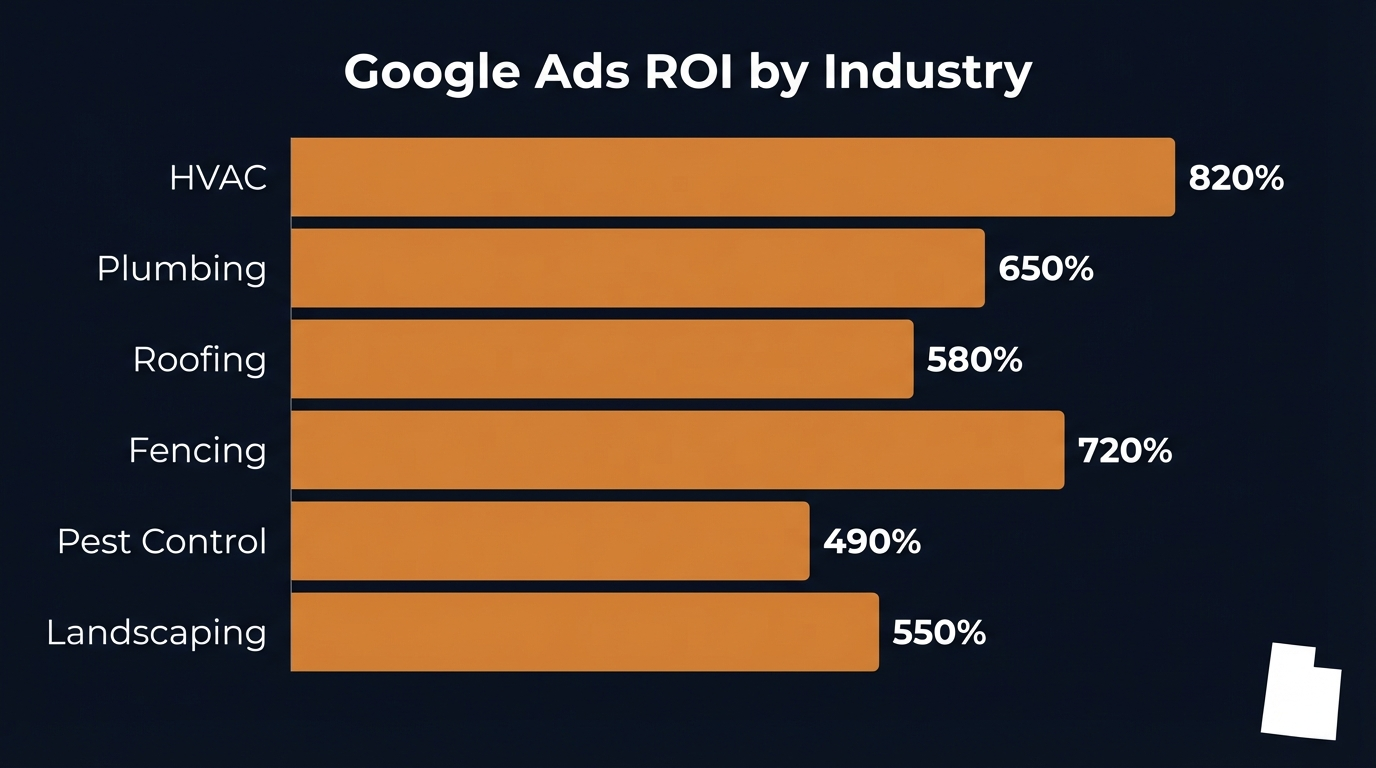
A few things stand out. Legal services pay the most per click, but a single client could be worth $5,000 to $50,000+. Home services and personal services get relatively cheap clicks with strong conversion rates — these are some of the best industries for Google Ads ROI in Utah.
Professional services lead the pack with a 4.60% lead-to-customer conversion rate, higher than any other B2B vertical. If you’re a CPA, consultant, or professional service provider along the Wasatch Front, Google Ads should be a core part of your marketing.
Budget Planning for Utah Businesses in 2026
The most common question we get: “How much should I spend on Google Ads?”
There’s no magic number, but there are rational ways to think about it. Here’s a framework:
The Math That Matters
Work backward from what a customer is worth to you:
- Average customer value: What does a typical customer spend with you? (Include repeat business over 12 months.)
- Cost per lead: Based on your industry benchmarks above, estimate what you’ll pay per lead.
- Lead-to-customer rate: What percentage of leads actually become paying customers? For most service businesses, this is 20-40%.
- Target number of new customers per month: How many new customers do you need?
Example for a Utah HVAC company:
- Average job value: $800
- Average cost per lead from Google Ads: ~$45
- Lead-to-customer rate: 30%
- Cost per acquired customer: $150 ($45 ÷ 0.30)
- Target: 20 new customers/month
- Monthly ad spend needed: ~$3,000
- Monthly revenue from those customers: ~$16,000
- ROAS: 5.3:1
That’s $3,000 in to generate $16,000 out. And that doesn’t count repeat customers or referrals from those initial clients.
Budget Tiers for Utah Businesses
| Monthly Budget | What You Get | Best For |
|---|---|---|
| $500-$1,500 | Basic Search campaign, limited keywords, testing phase | Solo operators, single-service businesses |
| $1,500-$5,000 | Full Search campaign, LSAs, remarketing, solid keyword coverage | Small businesses ready to grow, local service companies |
| $5,000-$15,000 | Multi-campaign strategy (Search + PMax + Demand Gen), A/B testing, full funnel coverage | Established businesses scaling up, multi-location companies |
| $15,000+ | Aggressive multi-channel, competitive bidding, market dominance | Enterprise, high-value industries (legal, medical, finance) |
For most Utah small businesses, the $1,500-$5,000 range is the sweet spot. Enough budget to gather meaningful data, optimize campaigns, and generate a real pipeline of leads — without betting the farm.
The 2026 Google Ads Strategy Playbook
Running ads is easy. Running profitable ads takes strategy. Here’s what’s working in 2026 for Utah businesses:
1. Start With Search, Expand From There
Don’t jump straight into Performance Max or Demand Gen. Start with a well-built Search campaign targeting your highest-intent keywords. Get that profitable. Then expand.
Google’s own recommended 2026 budget allocation looks like this:
- 50-60%: Search campaigns (high-intent, bottom-of-funnel)
- 30-40%: Performance Max or Demand Gen (broader reach, mid-funnel)
- 10-20%: Remarketing and brand campaigns (re-engage past visitors)
2. Build Landing Pages That Convert
Your ads are only half the equation. If you’re sending traffic to your homepage, you’re wasting money. Every campaign should have dedicated landing pages with:
- A clear headline matching the search intent
- Your phone number and a contact form above the fold
- Social proof (reviews, testimonials, certifications)
- A single clear call to action — don’t give visitors five options
- Fast load speed (under 3 seconds)
3. Use Negative Keywords Religiously
Negative keywords prevent your ads from showing on irrelevant searches. Without them, you’ll pay for clicks from people searching for “free,” “DIY,” “jobs,” and other terms that will never convert. Review your search terms report weekly and add negatives.
4. Set Up Proper Conversion Tracking
This sounds basic, but you’d be shocked how many accounts we audit that have broken or incomplete conversion tracking. If you can’t track phone calls, form submissions, and chat inquiries back to specific keywords, you’re flying blind. Use Google Tag Manager, call tracking (we use CallRail), and offline conversion imports.
5. Location Targeting: Be Specific
If you serve Ogden, don’t target all of Utah. If you serve the entire Wasatch Front, set radius targeting around your service area. Google lets you bid higher in areas that convert better — use location bid adjustments to put more budget toward your most profitable zip codes.
6. Ad Schedule Optimization
Not every hour of the day converts equally. Most service businesses see their best conversion rates during business hours (8 AM – 6 PM). Run your ads 24/7 initially to gather data, then use ad scheduling to reduce bids during low-converting hours or increase them during peak times.
7. Leverage Ad Extensions (Now Called Assets)
Every campaign should use:
- Sitelink assets (links to specific pages)
- Callout assets (highlight benefits: “Free Estimates,” “24/7 Service”)
- Call assets (clickable phone number)
- Location assets (show your address)
- Structured snippet assets (list services)
Extensions increase your ad’s real estate on the page and improve CTR by 10-15% on average. There’s no extra cost for adding them.
Common Google Ads Mistakes Burning Utah Ad Budgets
We manage around 20 Google Ads accounts. Here are the mistakes we see most often when we audit new accounts:
- No conversion tracking. If you don’t know which keywords generate leads, you can’t optimize. Period. We see this in about 40% of accounts we audit.
- Targeting “Utah” as a whole state. A plumber in Orem doesn’t need clicks from St. George. Tight geographic targeting saves budget and improves conversion rates.
- Using only broad match keywords with no negatives. Broad match casts a wide net. Without negative keywords, you’re catching a lot of garbage. One account we audited was spending $800/month on searches containing “salary” and “jobs” — people looking for employment, not services.
- Sending all traffic to the homepage. Your homepage is designed for multiple audiences. A search ad targets one specific need. Match the landing page to the search.
- Set it and forget it. Google Ads requires active management. Campaigns degrade over time as competition shifts, seasonal patterns change, and Google rolls out new features. If nobody has touched your account in three months, you’re bleeding money.
- Trusting Google’s automated recommendations blindly. Google’s “optimization score” is designed to get you to spend more, not to maximize your ROI. Not every recommendation is good. Accept the ones that make sense, dismiss the rest.
- No remarketing. 97% of visitors leave a website without converting. Remarketing shows your ads to people who already visited your site — they’re warm leads. A basic remarketing campaign costs very little and can double your overall conversion rate.
- Ignoring mobile. Over 60% of Google searches happen on mobile. If your landing pages aren’t mobile-friendly, you’re throwing away more than half your clicks.
What a $3,000/Month Google Ads Budget Looks Like in Utah
Let’s walk through a realistic scenario. A home services company in the Salt Lake Valley area wants to generate more leads using Google Ads.
Setup
- Monthly ad budget: $3,000
- Campaign type: Search + LSAs
- Target area: Salt Lake County + Davis County + Weber County
- Services: HVAC installation and repair
Expected Performance (Based on Industry Benchmarks)
- Average CPC: $6.50
- Monthly clicks: ~460
- Conversion rate: 5%
- Monthly leads: ~23
- Lead-to-customer rate: 30%
- New customers per month: ~7
- Average job value: $1,200
- Monthly revenue from ads: ~$8,400
- ROAS: 2.8:1
That’s a starting point. After 3-6 months of optimization — refining keywords, improving landing pages, building negative keyword lists, adjusting bids — we typically see ROAS climb to 4:1 or 5:1 as the campaign matures.
And remember: those 7 new customers don’t disappear after one job. A good HVAC company turns first-time customers into ongoing maintenance clients. The lifetime value of those customers could be 3-5x the initial job.
Frequently Asked Questions
How much should a Utah business spend on Google Ads per month?
Most local service businesses in Utah see solid results starting at $1,500–$3,000/month in ad spend, plus management fees. The right budget depends on your industry, competition level, and service area. An HVAC company covering the Wasatch Front will need more than a single-location barber shop. The key is starting with enough budget to generate meaningful data, then scaling what works.
How long does it take to see results from Google Ads?
You can start getting clicks and calls within 24–48 hours of launching a campaign. However, it typically takes 2–4 weeks of optimization to dial in targeting, bids, and ad copy for peak performance. Most campaigns hit their stride around the 60–90 day mark once the algorithm has enough conversion data to optimize effectively.
Is Google Ads worth it for small businesses in Utah?
Absolutely — and arguably more so than for large businesses. Small local businesses can target very specific geographic areas (like individual cities or zip codes in Utah) with laser precision. You’re not competing with national brands for local searches like “plumber in Ogden” or “roofing contractor Layton.” The ROI for well-managed local campaigns typically runs 3:1 to 8:1.
What’s the difference between Google Ads and SEO?
SEO (Search Engine Optimization) improves your organic rankings over time — it’s a long-term investment that takes 6–12 months to see significant results. Google Ads puts you at the top of search results immediately through paid placements. The best strategy uses both: Google Ads for instant visibility and lead flow, SEO for sustainable long-term growth. They complement each other perfectly.
Should I manage Google Ads myself or hire an agency?
You can learn the basics yourself, but Google Ads has gotten significantly more complex with AI bidding strategies, Performance Max campaigns, and constant platform changes. Most business owners who self-manage end up wasting 30–50% of their budget on poor targeting and missed optimizations. A good agency pays for itself through better performance — just make sure they’re transparent about spend, results, and strategy.
What types of Google Ads campaigns work best for Utah service businesses?
For most Utah service businesses, a combination of Search campaigns (targeting high-intent keywords) and Local Services Ads (pay-per-lead with Google Guarantee badge) delivers the best results. Performance Max campaigns are also increasingly effective for businesses with strong conversion tracking. The right mix depends on your industry, budget, and goals.
What’s a good conversion rate for Google Ads in 2026?
The average Google Ads conversion rate across industries is about 4.4% in 2026. Service businesses in Utah typically see 5–8% on well-optimized search campaigns. Top performers push past 10%. If your conversion rate is below 3%, there’s likely an issue with your landing page, ad relevance, or targeting that needs attention.
Getting Started: Your Next Steps
If you’ve read this far, you already know whether Google Ads makes sense for your business. (Spoiler: if you’re a Utah business competing for local customers, it does.)
Here’s how to move forward:
- Get your tracking in order. Before spending a dollar, make sure Google Analytics 4, Google Tag Manager, and conversion tracking are properly configured. This is non-negotiable.
- Define your goals. How many leads do you need per month? What’s a customer worth to you? These numbers determine your budget.
- Build campaign structure. Organize campaigns by service type and location. Don’t dump everything into one campaign.
- Create dedicated landing pages. One page per service, optimized for conversions.
- Launch, monitor, optimize. The first 30 days are about gathering data. Months 2-3 are about optimization. Month 4+ is where things really take off.
Or skip the learning curve entirely.
Let Techpros Run Your Google Ads
We’re a marketing team based right here in Ogden, Utah. We manage Google Ads accounts for businesses across the Wasatch Front and beyond. No long-term contracts. No BS reporting. Just results.
We manage over 50 active Google Ads accounts across industries — home services, legal, towing, medical, and more. We know Utah markets because we live here and work in them every day.
No commitment. We’ll look at your current campaigns (or help you plan new ones) and tell you exactly where the opportunities are. Call us at (385) 308-8060 or fill out our contact form.
Need Help With Your Marketing?
Get a free audit of your current online presence and see where you're leaving money on the table.
Get Your Free Audit